Change Style Indicator

Approach to change
In environments characterized by uncertainty, acceleration and continuous transformation, the ability to approach change with discernment and effectiveness has become a critical leadership capability.
The Change Style Indicator™ provides insight into how individuals perceive, approach and implement change within their professional environment.
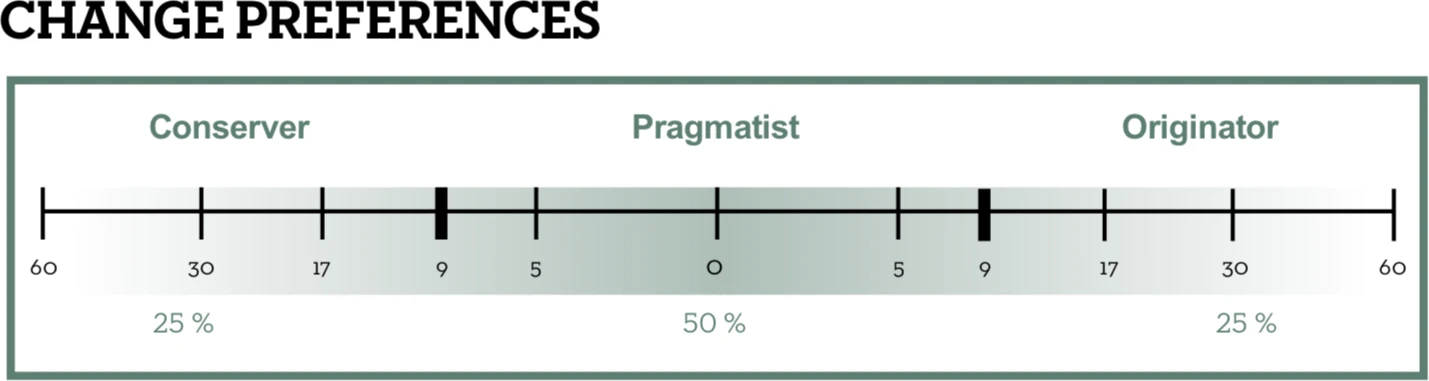
The tool identifies three approaches to change, Conserving, Improving and Creating, and highlights their relative weight in preferences and behaviours (dominant, supporting or less-used styles). It offers a structured understanding of an individual’s posture toward change, including their sources of stability and their areas of agility.
Used within a development context, the Change Style Indicator™ helps individuals better understand their reactions in times of change, expand their adaptive capacity and adjust their contribution according to the nature and pace of transformation.
The assessment can be implemented in individual coaching or in a team setting to foster a shared understanding of change approaches and support smoother collective adaptation.
Who is it for?
- Executives and managers operating in contexts of transformation or reorganization
- Leaders of cross-functional projects, particularly in multicultural or international environments
- Leaders who must balance operational stability with process evolution
- Managers leading teams through mergers, integration or transformation
- High-potential talents developing their careers in fast-changing environments
What is it for?
- Discover the three approaches to change (Conserving, Improving, Creating)
- Understand natural preferences and their leadership impact in situations of uncertainty or disruption
- Identify key levers for adaptation and engagement
- Support and stabilize transition and transformation phases
- Strengthen leadership effectiveness and team cooperation
Practical framework
- A confidential and easy-to-complete online questionnaire
- An individual (or team) report describing the change profile and its balance
- Identification of key strengths and potential risk areas in transformation contexts
- Insight into perception gaps and their impact on team dynamics
The feedback session
The feedback session provides an in-depth analysis of the individual’s approach to change, its alignment with organizational challenges and its practical implications in evolving professional situations.
In an individual coaching context, the process may be extended through a development plan aimed at strengthening agility, securing transitions and adjusting the leader’s contribution over time.
In a team setting, the assessment enables the comparison of profiles, helping teams understand the complementarity between the need for stability, continuous improvement and transformation, while anticipating potential areas of tension or resistance.